Modern Pentatonics for Jazz Guitar — Superimposition Finder | Niels Dalgaard

Free tool

Modern Pentatonics Finder

Not "which pentatonic goes with this chord", but which pentatonic, laid over this chord, gives the colour you want. Every pentatonic on all twelve roots, named by the degrees it makes against the chord and grouped from inside to outside, with the whole neck and the five boxes.

Any jazz chord symbol. You get every pentatonic on all twelve roots, named by the degrees it makes against the chord, from inside to outside.

Level
Pentatonics
Try

PDF PDF Tool — Run a search here and you can take the answer away as a clean sheet, made for printing.

PDF Tool

Take this to the music stand

Builds a clean sheet out of the answer above — the diagrams, the notes and the chord you asked for, drawn full size. No menus, no navigation, nothing else from the page. Save it as a PDF or send it straight to the printer.

  • Your results only, drawn full size
  • Made for paper — readable, nothing around it
  • Save as PDF or print it, straight from the browser
Free · one document every 24 hours

The map, on three chords

The same five-note shapes, laid over a minor, a dominant and a major chord. Read the last column: that is what you hear. These tables come from the same engine as the finder, built into the page.

Cm7

LevelPentatonicNotesAgainst Cm7
InsideC minor pentatonic
= Eb major pentatonic
C Eb F G Bb1 b3 11 5 b7
ColourF minor pentatonic
= Ab major pentatonic
F Ab Bb C Eb11 b13 b7 1 b3
ColourG minor pentatonic
= Bb major pentatonic
G Bb C D F5 b7 1 9 11
TensionBb minor pentatonic
= Db major pentatonic
Bb Db Eb F Abb7 b9 b3 11 b13
TensionEb minor pentatonic
= F# major pentatonic
Eb Gb Ab Bb Dbb3 #11 b13 b7 b9
OutsideG major pentatonic
= E minor pentatonic
G A B D E5 13 7 9 3

G7

LevelPentatonicNotesAgainst G7
InsideG major pentatonic
= E minor pentatonic
G A B D E1 9 3 5 13
TensionD minor pentatonic
= F major pentatonic
D F G A C5 b7 1 9 11
TensionG minor pentatonic
= Bb major pentatonic
G Bb C D F1 #9 11 5 b7
OutsideDb major pentatonic
= Bb minor pentatonic
Db Eb F Ab Bb#11 b13 b7 b9 #9

Gmaj7

LevelPentatonicNotesAgainst Gmaj7
InsideB minor pentatonic
= D major pentatonic
B D E F# A3 5 13 7 9
InsideG major pentatonic
= E minor pentatonic
G A B D E1 9 3 5 13
ColourA major pentatonic
= F# minor pentatonic
A B C# E F#9 3 #11 13 7
TensionE major pentatonic
= C# minor pentatonic
E F# G# B C#13 7 b9 3 #11
TensionC major pentatonic
= A minor pentatonic
C D E G A11 5 13 1 9
OutsideB major pentatonic
= G# minor pentatonic
B C# D# F# G#3 #11 b13 7 b9

Part of the Practice Pass

Pentatonics through a progression

One pentatonic per chord is the easy half. The half worth practising is the chain: the same five notes surviving a chord change, so the hand stays still while every note changes meaning under it — or, at the far end, going out on the dominant and coming home on the tonic. Then play it in JamShed, with the pentatonics named over the chart while the trio plays.

How far out
Presets

PDF PDF Tool — Run a search here and you can take the answer away as a clean sheet, made for printing.

PDF Tool

Take this to the music stand

Builds a clean sheet out of the answer above — the diagrams, the notes and the chord you asked for, drawn full size. No menus, no navigation, nothing else from the page. Save it as a PDF or send it straight to the printer.

  • Your results only, drawn full size
  • Made for paper — readable, nothing around it
  • Save as PDF or print it, straight from the browser
Free · one document every 24 hours

The books behind this tool

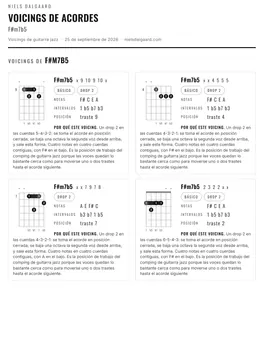
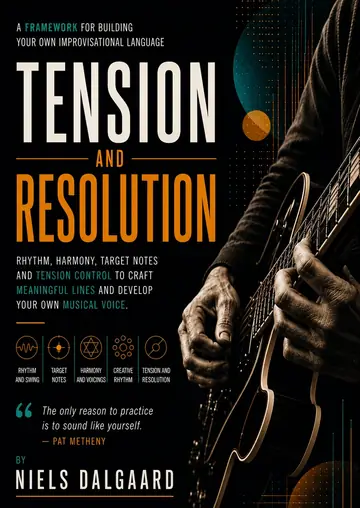
Knowing that D minor pentatonic gives the 9th and the 13th over Cm7 is a fact; hearing when to reach for it is a language. Tension and Resolution is where pentatonic superimposition sits inside a whole system of tension and release — next to triad pairs, side slipping and outside playing — with the exercises to make it sound intentional.

See all the books
Completely free Free edition · All instruments

The Jazz Roadmap Lite

The sixteen stages of the roadmap, a paragraph each, and which book develops every one of them. Twelve pages, fifteen minutes — enough to know where you are standing and what comes next. Download the free PDF →

Superimposition, not "the scale of the chord"

The minor pentatonic is one of the first things a guitarist learns, and the problem with it in jazz is not the notes — it is the habit. Played from the root of every chord, in the familiar boxes, it sounds like rock over jazz changes.

Modern jazz uses the same five-note shapes as colour laid over the harmony. The question changes from "which pentatonic goes with this chord?" to "which pentatonic, played over this chord, produces the sound I want?". Over Cm7, D minor pentatonic gives the 9th and the dorian 13th at once; over Gmaj7, A major pentatonic gives the #11. No new shape, a completely different sound.

Relative pentatonics are the same five notes

The most common mistake in writing about this: offering Eb major pentatonic as the "modern" choice over Cm7. Eb major pentatonic is Eb F G Bb C — exactly the notes of C minor pentatonic. It adds nothing; it only moves where you think the phrase from.

So the finder works with sets of notes, not names. Each set of five notes appears once, under the name that reads best over the chord, with its other name beside it. New colour only appears when the notes change, never when the name does.

Inside, colour, tension, outside

Every note of every pentatonic is classified against the chord: a chord tone; a tension the chord takes (9, 11 on a minor chord, 13); an altered tension (b9, #9, #11, b13) the symbol did not ask for; a note that rubs, a semitone over the third or the seventh; or a note outside the chord, like the major seventh over a dominant. The level comes from those counts.

None of the four is wrong. Inside is where a phrase starts and lands. Colour is new sound with nothing against the chord. Tension has one note that has to go somewhere. Outside is a second harmony on top of the first: enter it consciously on a strong beat, stay briefly, and leave by a semitone onto a chord tone. Change the chord symbol and the levels change with it — Db major pentatonic is outside over G7 and is the chord itself over G7alt.

Beyond major and minor: one moved finger

Besides the major pentatonic and its relative minor, the finder uses three more five-note shapes, each one the familiar box with a single note moved: the minor 6 pentatonic (1 b3 4 5 6, which is also a dominant pentatonic a fourth up), the major b6 (1 2 3 5 b6) and the m7b5 pentatonic (1 b3 4 b5 b7). They are five-note cuts of the melodic and harmonic minor colours — the lydian dominant, the altered sound — at the price of one finger.

Turn them off with the filter if you want only the two pentatonics you already know.

Play them by interval, not by scale

Run up and down in order, any pentatonic sounds like an exercise. Moved in groups of four (the 1-2-3-5 cell), or skipping every other note — which in a pentatonic is a chain of fourths almost everywhere — the same five notes sound angular and modern. With the pass, every box in the finder writes out these patterns as tab, up and down.

What is free, and what the pass adds

The finder is free and stays free: every pentatonic over any chord, the levels, the degrees, the whole neck and the five boxes, with no account and no limit. The Practice Pass adds the practice on top: progressions chained one pentatonic per chord, interval patterns as tab for any box, and in JamShed the pentatonics named over the chart while the trio plays — plus everything else in the pass. One payment, no subscription, no expiry.

Explore more