Free tool · No account
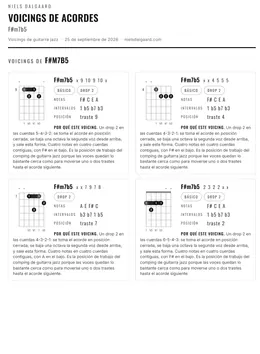
Chords a bassist can play: guide-tone double stops, tenths, shells and upper structures, for any jazz symbol — and only where they sound clear. Below a certain pitch a third turns to mud; the finder knows where.
Any jazz chord symbol: Cmaj7, Dm9, G13, F#m7b5, Bb7alt, Ebm6, A7#11, Dsus4.
PDF PDF Tool — Run a search here and you can take the answer away as a clean sheet, made for printing.
Builds a clean sheet out of the answer above — the diagrams, the notes and the chord you asked for, drawn full size. No menus, no navigation, nothing else from the page. Save it as a PDF or send it straight to the printer.
 Project 03 · Harmony
 Project 05 · Harmony
 Project 01 · All instruments
Type the changes and the finder chains the shapes that move the least, once with the lowest note on the lowest string and once a string higher.
Two chords or more, separated by spaces or by |. The tool picks the shapes that move the least between one chord and the next.
PDF PDF Tool — Run a search here and you can take the answer away as a clean sheet, made for printing.
Builds a clean sheet out of the answer above — the diagrams, the notes and the chord you asked for, drawn full size. No menus, no navigation, nothing else from the page. Save it as a PDF or send it straight to the printer.
The same interval sounds clear high up and muddy low down: the lower the two notes, the closer their overtones rub. That is why a bassist plays a chord as a tenth rather than a third, puts the seventh above the root before the third, and keeps three-note structures on the high strings. Every voicing here has passed that test: thirds only from about F2 up, seconds from about B2, fifths and sevenths from the bottom of the instrument.
Two notes are often enough. The third and the seventh say everything about the chord’s quality; under a soloist, on a ballad or in a duo, that double stop is the bassist’s comping.
A walking line for any progression, in five stages.
Open →Double stops, tenths and shells, where they sound clear.
Open →The scale for each chord: the road between the chord tones.
Open →The chord tones alone: what a walking line is built on.
Open →