Free to try · The criteria with the Practice Pass
Write a progression and decide how it should move: the top note still or singing your melody, the bass falling through inversions, the guide tones resolving, the hand in one place. The tool searches every playable voicing of every chord for the chain that does it.
Two chords or more, separated by spaces or by |. Any jazz chord symbol: Dm9, G7alt, F#m7b5, Bb/D…
My melody: one note per chord, in order (F F E). A dash leaves a chord free.
PDF PDF Tool — Run a search here and you can take the answer away as a clean sheet, made for printing.
Builds a clean sheet out of the answer above — the diagrams, the notes and the chord you asked for, drawn full size. No menus, no navigation, nothing else from the page. Save it as a PDF or send it straight to the printer.
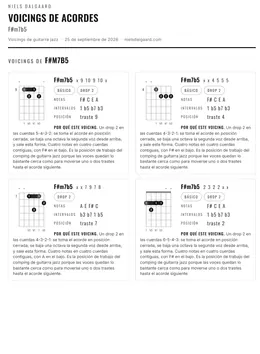
 Project 10 · Jazz guitar
 Project 04 · Jazz guitar
 Project 07 · Jazz guitar

Every chord has dozens of playable voicings, and a progression of eight chords has more chains of them than anyone could try. The tool does not try them one by one. It gives every shape a cost of its own (how good a grip it is) and every move between two shapes a cost (how far the voices travel, and whether that move does what you asked), and then finds the cheapest chain through the whole progression in one pass.
That is also why the alternatives of each chord come ranked: the number under each one is how much worse the best chain through it would be. Lock the one you like and the rest of the progression re-arranges itself around it.
When something you asked for is impossible with those chords — no note is common to Dm7, G7 and Cmaj7, so no top note can stay still through all three — the page says so instead of pretending.
Every playable voicing of one chord, with what each one is.
Open →The key, the Roman numerals and the function of every chord.
Open →The changes of the standards, analysed: copy a progression from there.
Browse →Then play them with a trio, at any tempo and key.
Play →