Horace Silver · 1965 · F minor · AAB, 24 bars
The D♭7 to C7 in bars five and six is a tritone substitute resolving down a semitone into the real dominant. Two dominants in a row, and the bass line is what tells you which is which.
Analyzed excerpt
Section: A1 · Bars 1–8
Fm7 | Fm7 | Eb7 | Eb7 | Db7 | C7 | Fm7 | Fm7
This is a short excerpt quoted for analysis, not the full chart, and this composition is very likely still in copyright. Published versions and recordings disagree with each other about the rest of the tune, and often about these bars too.
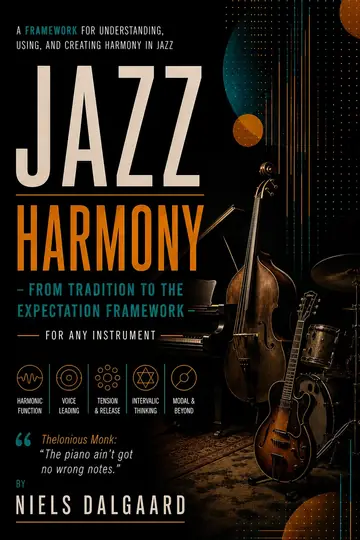
Every one of these tunes is assembled out of the same handful of harmonic resources. Jazz Harmony is those resources, explained in the order in which they build on each other.
| Chord | Roman numeral | Function | What it is doing | Confidence |
|---|---|---|---|---|
| Fm7 | i | Tonic | Fm7 is the tonic of Fm. It is where the progression is at rest. | High |
| Fm7 | i | Tonic | Fm7 is the tonic of Fm. It is where the progression is at rest. | High |
| Eb7 | bVII7 | Other | Eb7 is bVII7: the subtonic as a dominant seventh. It usually moves to bIII or steps down to the tonic. Also readable as V7/bIII. | Medium |
| Eb7 | bVII7 | Other | Eb7 is bVII7: the subtonic as a dominant seventh. It usually moves to bIII or steps down to the tonic. Also readable as V7/bIII. | Medium |
| Db7 | subV7/V | Dominant | Db7 is a tritone substitute — subV7/V. It carries the same tritone as G7, the real dominant of C, but resolves down a semitone instead of down a fifth. Also readable as bVI7. | High |
| C7 | V7 | Dominant | C7 is the dominant of Fm. In a minor key it borrows its major third from harmonic minor — that raised note is the leading tone. | High |
| Fm7 | i | Tonic | Fm7 is the tonic of Fm. It is where the progression is at rest. | High |
| Fm7 | i | Tonic | Fm7 is the tonic of Fm. It is where the progression is at rest. | High |
High, medium and low next to each numeral are judgements about musical context, not probabilities. A low rating marks a bar that can honestly be read more than one way. How the ratings are decided →
Against a tonic of F minor the passage numbers as i – bVII7 – subV7/V – V7. Inside those 8 chords there is a tritone substitute. Strip it to two notes per chord, the third and the seventh, and play it under tempo. Eb7 gives you G and Db; follow that pair from chord to chord and the voice leading becomes audible in a way the root motion never makes it. Once you can hear it here, it is hard to miss in Blues for Alice, All Blues and So What.
A sixteen-bar minor form over a bossa-derived bass figure, and the harmony is deliberately sparse — long stretches on one chord, then a cadence. The one device worth naming is the approach to the tonic from a semitone above, a tritone substitution used at the end of the form, which supplies the piece’s only real harmonic surprise and does it in the same place every chorus. Everything else is texture and groove.
Horace Silver recorded it in 1965; the album cover shows his father, and the rhythm came from a trip Silver made to Brazil combined with the Cape Verdean music he grew up with. Its bass figure was borrowed by Steely Dan for “Rikki Don’t Lose That Number” in 1974, a lift Silver acknowledged without complaint and which brought the tune a second audience.
Load the progression and start altering it. Every edit is re-read from scratch, so you can test a hunch about one chord without rewriting the rest.
What this device is, and the other standards in the library that use it.
Read →Charlie Parker · 1951 · F major
Chord progression →Miles Davis · 1959 · G major
Chord progression →Miles Davis · 1959 · D dorian / E♭ dorian
Chord progression →The families every standard is assembled from, with examples from the library.
Read →