Free tool · No account
Analyze jazz chord progressions, harmonic functions, Roman numerals, secondary dominants, ii-V-I progressions and more — with an explanation of every reading, not just a label.
Separate chords with spaces. Use | for bar lines. Bar numbers, line breaks and pasted lead-sheet text all work.
Or start from a tune: 100 jazz standards with their chords already analysed →
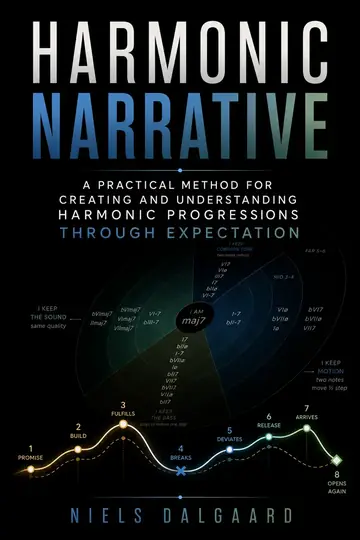
This analyzer answers the traditional question: what function does this chord serve? There is a second question underneath it — what was the listener expecting, and what made them expect it? That question is the subject of these three.
Or start with The Line of Expectation, which the three of them come out of
A jazz harmony analyzer takes a chord progression and works out what the chords are doing. Not what they are called — you already know that — but which key they belong to, what Roman numeral each one carries, and what job it performs inside the phrase: setting up, pulling, or arriving.
Most chord tools stop at recognition: you type A7 and they tell you it contains A, C#, E and G. That is spelling, not analysis. This tool is built to answer the question a musician actually has, which is why that chord is there — and to say so in a sentence, not in a symbol.
It is free, it runs entirely in your browser, it needs no account, and nothing you type is stored anywhere.
Jazz harmony is context-dependent, and a lot of chords have more than one honest reading. Rather than inventing certainty, the analyzer labels every claim as high, likely or possible, and shows the alternative interpretation when there is one. A Bb7 before Cmaj7 is a backdoor dominant, but it is also the V7 of Eb — you should be told both, and told which one the context favours.
Here is what the analyzer returns for Cmaj7 | A7 | Dm7 | G7 | Cmaj7. The key is C major, with high confidence: the progression opens and closes on the tonic and contains a complete ii-V-I.
| Chord | Roman numeral | Function | Analysis |
|---|---|---|---|
| Cmaj7 | I | Tonic | The tonal center. Where the progression is at rest. |
| A7 | V7/ii | Dominant | A secondary dominant. A7 is the dominant of D minor, not of C, so it borrows the pull of a V-I and points it at the ii chord. |
| Dm7 | ii | Predominant | The classic predominant. It prepares the dominant and almost always moves to it. |
| G7 | V7 | Dominant | Its third and seventh form a tritone — B and F — and that tritone is what makes the tonic feel due. |
| Cmaj7 | I | Tonic | Resolution. The tritone B-F contracts to C and E, and the phrase closes with an authentic cadence. |
The analyzer also reports the pattern — a complete ii-V-I in C — and the relationship A7 → Dm7, which it explains as a secondary dominant resolving to its temporary tonic: for two chords, the harmony behaves as if D minor were the key.
The tool does this automatically, but the order matters if you are doing it by hand — and knowing the order is what lets you argue with the tool when you disagree with it.
Click any of these to run it through the analyzer.
The sentence jazz harmony is built out of: predominant, dominant, tonic. In C major, Dm7 G7 Cmaj7. In minor the ii becomes half-diminished and the dominant borrows its leading tone from harmonic minor.
The turnaround: four chords that send a section back to its beginning. Replace the I with iii and the bass keeps moving instead of sitting still.
A dominant seventh aimed at a degree other than the tonic. A7 in C major is V7/ii: for two chords the harmony behaves as if D minor were the key, then hands the phrase back.
Fm7 Bb7 Cmaj7. The iv and bVII7 are borrowed from C minor, and the tonic is reached from a whole tone below instead of from the fifth above. It arrives without a leading tone, and that is what makes it sound warm rather than final.
Db7 replaces G7 because they share the same tritone — B and F. The pull is identical; only the bass changed, and now it walks down by semitone: D, Db, C.
Chords borrowed from the parallel mode. Minor iv in a major key is the most recognisable sound in the repertoire; bVI and bVII7 come from the same place.
C C#dim7 Dm7. The diminished chord fills the semitone between two diatonic chords. It is a dominant with its root removed, which is why it pulls even though it belongs to no key.
Roots moving by major thirds, dividing the octave into three equal parts. No single key contains it, so the analyzer will say so — and label its confidence honestly instead of forcing a tonic.
Each of these pages explains one device properly and then lists the standards in the library whose chords actually demonstrate it.
Why three chords became the sentence of an entire language — and what changes in minor.
Read →How a chord borrows the pull of a cadence and aims it somewhere else.
Read →Two dominants, one tritone: the substitution that changed the bass line of jazz.
Read →Borrowed chords: where minor iv, bVI and bVII7 come from, and why they sound like that.
Read →Arriving at the tonic from below, without a leading tone — and why it sounds warm.
Read →How to read the numerals this tool produces, including the slashed ones.
Read →The analyzer accepts the notation you already use. All of these are read as the same chord: Cmaj7, CM7, Cma7, CΔ. Minor can be Cm7, Cmin7, C-7. Half-diminished can be Cm7b5 or Cø. Diminished can be Cdim7, Co7 or C°7. Alterations, slash basses and suspensions all work: G7alt, C7b9, F#7#11, Cmaj7/E, G7sus4, C6/9.
For the layout: spaces separate chords, | separates bars, and line breaks count as bar lines too. You can paste several bars of a lead sheet straight in, bar numbers included — 1. Cmaj7 | 2. A7 works, and so do repeat marks.
Anything the parser cannot read is listed and skipped rather than silently dropped, so you always know what was analysed.
Every analysis has its own address. Press Share analysis and you get a link that carries the progression inside it, so whoever opens it sees the same reading — useful for a lesson, a rehearsal, or an argument about whether that chord is really a tritone sub.
Every chord the analyzer reads gets a confidence rating alongside its Roman numeral, and the ratings are judgements about musical context, not statistical probabilities. High means the surrounding chords strongly support this reading and a second opinion would almost certainly agree. Medium means more than one interpretation is plausible and this is the one that fits the context best. Low means the context permits several reasonable readings and any of them could be defended — which is usually a sign that the passage is genuinely ambiguous rather than that the analysis has failed.
A low rating is worth stopping on. It usually marks the places where players disagree about a tune, and those are the bars where knowing why the reading is uncertain teaches more than the reading itself would.