Roman numeral analysis in Jazz — Explained, With 14 Standards | Niels Dalgaard

Harmonic concept

Roman numeral analysis in jazz

What the numerals mean, how the slashed ones work, and where the notation stops being able to describe what you are hearing.

The basic system

A Roman numeral names a chord by its position in a key rather than by its letter. Cmaj7 in C major is I; the same chord in G major is IV. That is the entire point of the notation: it describes a function, so the analysis of a tune survives transposition.

Case carries the quality. Upper case is major or dominant; lower case is minor or diminished. A degree that is not in the key gets an accidental in front of it, written flat-side by convention: bVI, bVII, bII. This holds even inside a minor key, where bIII, bVI and bVII keep their flats although they are diatonic there.

The seven degrees of a major key

The books behind this page

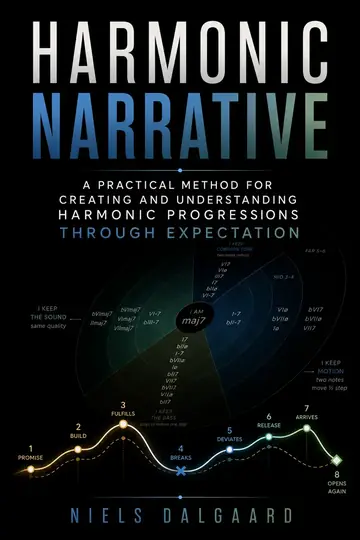
One device, explained on one page. Jazz Harmony is the whole vocabulary in one place: what each resource is, how it is built, when it is used, why it works — and what it does to what the listener expects.

The slashed numerals

This is where jazz notation earns its keep. A slash means "of": the numeral before it describes the chord’s role, and the numeral after it names the degree that role is aimed at.

A slashed numeral always describes a temporary allegiance. It says: for the length of this chord, the harmony is treating some other degree as a tonic. It does not say the key changed, and reading it that way is the most common error in student analysis.

What the numerals cannot tell you

Roman numerals describe position and quality. They do not describe register, voicing, rhythm, duration or what the melody is doing — and all four of those can overturn a functional reading. A V7 that lasts an eighth note in the middle of a bar and a V7 that occupies two bars are the same numeral and completely different musical events.

They also flatten ambiguity. A chord that could reasonably be read two ways gets one label, and the label then looks like a fact. That is why this analyzer publishes a confidence level with every numeral and shows the alternative reading when there is one: the numeral is a claim, and a claim should come with its evidence.

Run the third example above — Cmaj7 | A7 | Dm7 | Db7 | Cmaj7 — and you get I, V7/ii, ii, subV7, I: two slashed numerals in five chords, and neither of them means the piece left C major.

Standards for practising Roman numeral analysis (14)

Every tune below is here because the analyzer found this device in the excerpt printed on its page — not because someone decided the tune belongs in this category. Each row links to the full analysis.

StandardKeyAnalyzed excerptWhat it shows
Now’s the TimeF majorF7 | Bb7 | F7 | F7 | Bb7 | Bb7 | F7 | D7 | Gm7 | C7 | F7 D7 | Gm7 C7A complete ii-V-I and a secondary dominant
Billie’s BounceF majorF7 | Bb7 | F7 | Cm7 F7 | Bb7 | Bdim7 | F7 | D7 | Gm7 | C7 | F7 D7 | Gm7 C7A complete ii-V-I and a secondary dominant
Straight, No ChaserF majorF7 | Bb7 | F7 | F7 | Bb7 | Bb7 | F7 | F7 | Gm7 | C7 | F7 | C7A complete ii-V-I
C Jam BluesC majorC7 | C7 | C7 | C7 | F7 | F7 | C7 | C7 | G7 | F7 | C7 | G7Plain diatonic motion
Blue MonkB♭ majorBb7 | Eb7 | Bb7 | Bb7 | Eb7 | Edim7 | Bb7 | G7 | Cm7 | F7 | Bb7 G7 | Cm7 F7A complete ii-V-I and a secondary dominant
Bags’ GrooveF majorF7 | Bb7 | F7 | F7 | Bb7 | Bb7 | F7 | F7 | Gm7 | C7 | F7 D7 | Gm7 C7A complete ii-V-I and a secondary dominant
Tenor MadnessB♭ majorBb7 | Eb7 | Bb7 | Fm7 Bb7 | Eb7 | Eb7 | Bb7 | G7 | Cm7 | F7 | Bb7 G7 | Cm7 F7A complete ii-V-I and a secondary dominant
Freddie FreeloaderB♭ majorBb7 | Eb7 | Bb7 | Bb7 | Eb7 | Eb7 | Bb7 | Bb7 | F7 | Eb7 | Ab7 | Bb7A secondary dominant
St. Louis BluesG majorG7 | G7 | G7 | G7 | C7 | C7 | G7 | G7 | D7 | D7 | G7 | D7Plain diatonic motion
Watermelon ManF majorF7 | F7 | F7 | F7 | Bb7 | Bb7 | F7 | F7 | C7 | Bb7 | C7 | Bb7Plain diatonic motion
Ain’t Misbehavin’E♭ majorEbmaj7 | Edim7 | Fm7 | Bb7 | Ebmaj7A complete ii-V-I, a diminished connector and a turnaround
Basin Street BluesB♭ majorBb | Bdim7 | Cm7 | F7 | BbA complete ii-V-I, a diminished connector and a turnaround
St. ThomasC majorC | C | G7 | C | C | C | G7 | CPlain diatonic motion
The SidewinderF majorF7 | F7 | F7 | F7 | Bb7 | Bb7 | F7 | F7 | Db7 | Eb7 | F7 | F7A tritone substitute and a backdoor resolution

Hear it in your own progression

Paste a progression of your own, or load one of these, and see where the device shows up.

Try

Related