Charlie Parker · 1947 · A♭ major · AABC, 32 bars
Indiana’s changes with a melody that never stops for breath. Because the harmony is public domain and famous, every note of the line can be read against a progression you already know.
Analyzed excerpt Valid harmonic variant
Section: A · Bars 1–8
Ab | Ab | Ab7 | Ab7 | Db | Dbm | Ab | F7
The excerpt follows Indiana, the tune Donna Lee is built on. Bebop charts commonly bebop-ise bar 2 into E♭m7 A♭7 instead of holding the tonic.
This is a short excerpt quoted for analysis, not the full chart, and this composition is very likely still in copyright. Published versions and recordings disagree with each other about the rest of the tune, and often about these bars too.
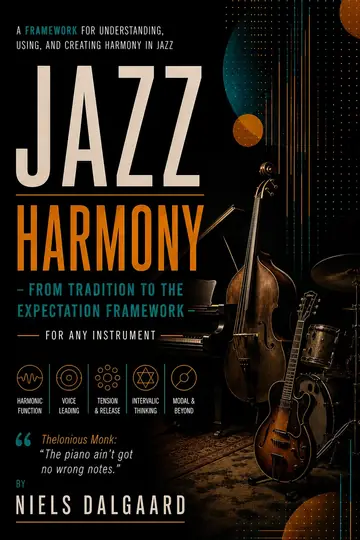
Every one of these tunes is assembled out of the same handful of harmonic resources. Jazz Harmony is those resources, explained in the order in which they build on each other.
| Chord | Roman numeral | Function | What it is doing | Confidence |
|---|---|---|---|---|
| Ab | I | Tonic | Ab is the tonic of Ab. It is where the progression is at rest. | High |
| Ab | I | Tonic | Ab is the tonic of Ab. It is where the progression is at rest. | High |
| Ab7 | I7 | Tonic | Ab7 is the tonic, but built as a dominant seventh — the sound that defines the blues. The tonic keeps a b7 and stays at home anyway. | High |
| Ab7 | I7 | Tonic | Ab7 is the tonic, but built as a dominant seventh — the sound that defines the blues. The tonic keeps a b7 and stays at home anyway. Also readable as V7/IV. | Medium |
| Db | IV | Predominant | Db is the IV chord of Ab: subdominant. It moves away from the tonic without creating the pull of a dominant. | High |
| Dbm | iv | Predominant | Dbm is a minor iv in a major key, borrowed from the parallel minor. Its b6 pulls down into the third of the tonic — one of the most recognisable sounds in the repertoire. | Medium |
| Ab | I | Tonic | Ab is the tonic of Ab. It is where the progression is at rest. | High |
| F7 | V7/ii | Dominant | F7 is functioning as V7/ii: a secondary dominant. It is the dominant of Bb, not of the home key, so it borrows the pull of a V-I and points it at ii instead. | Medium |
High, medium and low next to each numeral are judgements about musical context, not probabilities. A low rating marks a bar that can honestly be read more than one way. How the ratings are decided →
Against a tonic of Ab major the passage numbers as I – I7 – IV – iv – V7/ii. Inside those 8 chords there is at least one secondary dominant. Strip it to two notes per chord, the third and the seventh, and play it under tempo. Ab7 gives you C and Gb; follow that pair from chord to chord and the voice leading becomes audible in a way the root motion never makes it. Once you can hear it here, it is hard to miss in Stella by Starlight, How High the Moon and Ornithology.
A contrafact on Back Home Again in Indiana, taken considerably faster than the source and written as a continuous stream of eighth notes with almost no rests for thirty-two bars. The harmony adds ii chords in front of the original’s dominants, which gives the line more places to turn, but the real difficulty is physical rather than harmonic: it is one long phrase, and the standard test of having learned it is being able to play it without breathing in the wrong place.
Recorded in 1947 at a Charlie Parker session and credited to Miles Davis, who was on the date — the attribution has been questioned for decades, with several participants recalling it differently. It is a standard audition piece for bass players since Jaco Pastorius recorded it on electric bass in 1976, a version that changed expectations of the instrument permanently.
Load the progression and start altering it. Every edit is re-read from scratch, so you can test a hunch about one chord without rewriting the rest.
What this device is, and the other standards in the library that use it.
Read →Victor Young · 1944 · B♭ major
Chord progression →Morgan Lewis · 1940 · G major
Chord progression →Charlie Parker · 1946 · G major
Chord progression →The families every standard is assembled from, with examples from the library.
Read →