Miles Davis · 1954 · E♭ major · ABAC, 32 bars
Two ii–Vs that do not resolve where they point: the first is the ii–V of D♭ and lands on F minor instead, the second is the backdoor, the ii–V of the flat seventh that leads home from below.
Modal interchange ii-V-I Secondary dominants Backdoor progression
Analyzed excerpt
Section: A · Bars 1–8
Ebmaj7 | Ebmaj7 | Ebm7 | Ab7 | Fm7 | Fm7 | Abm7 | Db7
Every one of these tunes is assembled out of the same handful of harmonic resources. Jazz Harmony is those resources, explained in the order in which they build on each other.
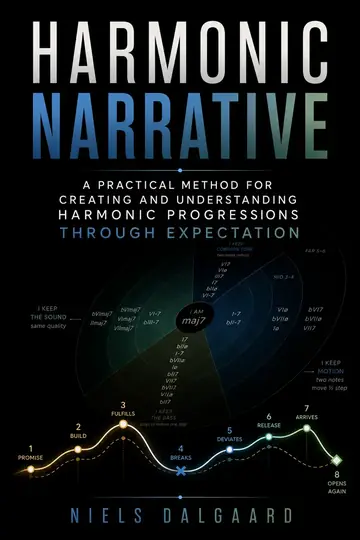
See all the books
The whole form, not just these bars: JamShed’s trio — double bass, drums and piano — plays it with you at the tempo and in the key you choose. Loop the bars that trip you up, mute the instrument you play, share the link.
| Chord | Roman numeral | Function | What it is doing | Confidence |
|---|---|---|---|---|
| Ebmaj7 | I | Tonic | Ebmaj7 is the tonic of Eb. It is where the progression is at rest. | High |
| Ebmaj7 | I | Tonic | Ebmaj7 is the tonic of Eb. It is where the progression is at rest. | High |
| Ebm7 | ii/bVII | Predominant | Ebm7 is the ii of a secondary ii-V. Together with Ab7 it prepares Db, so the pair tonicizes bVII without leaving the key. Also readable as i. | Medium |
| Ab7 | IV7 | Predominant | Ab7 is the IV of a blues, built as a dominant seventh. In this context that is its normal quality, not a dominant of anything. Also readable as V7/bVII / subV7/iii. | Low |
| Fm7 | ii | Predominant | Fm7 is the ii chord of Eb: the classic predominant. It prepares the dominant and almost always moves to it. | High |
| Fm7 | ii | Predominant | Fm7 is the ii chord of Eb: the classic predominant. It prepares the dominant and almost always moves to it. | High |
| Abm7 | iv | Predominant | Abm7 is a minor iv in a major key, borrowed from the parallel minor. Its b6 pulls down into the third of the tonic — one of the most recognisable sounds in the repertoire. Also readable as ii/bIII. | Medium |
| Db7 | bVII7 | Modal interchange | Db7 is bVII7 — the backdoor dominant. It comes from the parallel minor and resolves up a whole tone to the tonic instead of down a fifth. Also readable as V7/bIII / subV7/vi. | Medium |
A ii-V pointing at Db, which never arrives. The preparation is complete, the resolution is not.
A ii-V pointing at Gb, which never arrives. The preparation is complete, the resolution is not.
Modal interchange: Db7 come from the parallel mode of Eb, not from the key itself.
High, medium and low next to each numeral are judgements about musical context, not probabilities. A low rating marks a bar that can honestly be read more than one way. How the ratings are decided →
The complete analysis of Four — every chord of the whole form, with its Roman numeral and its ii–V–Is marked on the chart — is in JamShed with the Practice Pass, ready to print. Open it in JamShed →
In E♭ major the excerpt reads I – ii/bVII – IV7 – ii – iv – bVII7. Inside those 8 chords there is a ii-V that is left unresolved and a chord borrowed from the parallel mode. Play it slowly with only two voices — the third and seventh of each chord. In Ab7 those are C and Gb, and watching where that pair goes next tells you more about the progression than the root movement does. The same device turns up in Misty, ’Round Midnight and Just Friends, in other keys and at other tempos.
Thirty-two bars, ABAC. The A section is the excerpt: two ii–Vs that land somewhere unexpected, the second being the backdoor ii–V that returns to E♭ from below. The second half of each eight-bar phrase is a chromatic ii–V pair — F♯m7–B7 into Fm7–B♭7 — so the tune alternates between the backdoor and the side-slip, two different ways of approaching the same tonic.
Credited to Miles Davis, who recorded it in 1954 and kept it in his repertoire for a decade; the live album Four & More (1964) takes its title from it. The composition is often attributed instead to the saxophonist Eddie “Cleanhead” Vinson, as is Tune Up.
Take these bars into the analyzer and interfere with them. The fastest way to learn what a chord was doing is to remove it and read what the analysis says instead.
What this device is, and the other standards in the library that use it.
Read →What this device is, and the other standards in the library that use it.
Read →Erroll Garner · 1954 · E♭ major
Chord progression →Thelonious Monk · 1944 · E♭ minor
Chord progression →John Klenner · 1931 · G major
Chord progression →The families every standard is assembled from, with examples from the library.
Read →