Satin Doll Chord Progression & Harmonic Analysis | Niels Dalgaard

Duke Ellington · 1953 · C major · AABA, 32 bars

Satin Doll — Chord Progression & Harmonic Analysis

A tune made almost entirely of ii-V pairs that do not resolve, ending on one that has been substituted. The tonic appears once, at the very end, and by then you have wanted it for six bars.

ii-V-I Secondary dominants Tritone substitution

Chord progression

Analyzed excerpt

Section: A1 · Bars 1–7

Dm7 G7 | Dm7 G7 | Em7 A7 | Em7 A7 | Am7 D7 | Abm7 Db7 | Cmaj7

This is a short excerpt quoted for analysis, not the full chart, and this composition is very likely still in copyright. Published versions and recordings disagree with each other about the rest of the tune, and often about these bars too.

The books behind this page

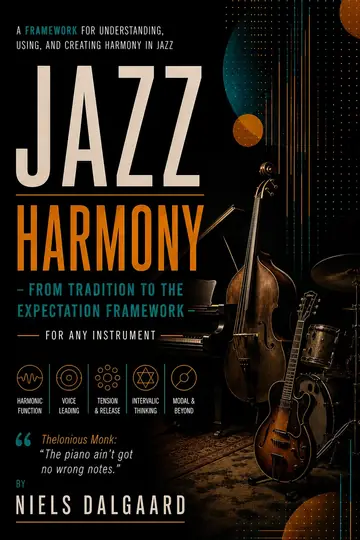
Every one of these tunes is assembled out of the same handful of harmonic resources. Jazz Harmony is those resources, explained in the order in which they build on each other.

Harmonic analysis

Key
C major
Tonal center
C
Confidence
Low
Chords analysed
13
ChordRoman numeralFunctionWhat it is doingConfidence
Dm7iiPredominantDm7 is the ii chord of C: the classic predominant. It prepares the dominant and almost always moves to it.High
G7V7DominantG7 is the dominant of C. Its third and seventh form a tritone, and that tritone is what makes the tonic feel due.High
Dm7iiPredominantDm7 is the ii chord of C: the classic predominant. It prepares the dominant and almost always moves to it.High
G7V7DominantG7 is the dominant of C. Its third and seventh form a tritone, and that tritone is what makes the tonic feel due.High
Em7iiiTonicEm7 is the iii chord. It shares three notes with the tonic, so it often works as a softer stand-in for it. Also readable as ii/ii.Low
A7V7/iiDominantA7 is functioning as V7/ii: a secondary dominant. It is the dominant of D, not of the home key, so it borrows the pull of a V-I and points it at ii instead.Low
Em7iiiTonicEm7 is the iii chord. It shares three notes with the tonic, so it often works as a softer stand-in for it. Also readable as ii/ii.Low
A7V7/iiDominantA7 is functioning as V7/ii: a secondary dominant. It is the dominant of D, not of the home key, so it borrows the pull of a V-I and points it at ii instead.Low
Am7viTonicAm7 is the vi chord — the relative minor. It shares three notes with the tonic and often replaces it. Also readable as ii/V.Medium
D7V7/VDominantD7 is functioning as V7/V: a secondary dominant. It is the dominant of G, not of the home key, so it borrows the pull of a V-I and points it at V instead.Low
Abm7bviOtherAbm7 does not take a functional role in C. It sits on bVI and is best heard as colour, or as a sign that the tonal center has moved.Low
Db7subV7DominantDb7 is a tritone substitute for the dominant. It shares its tritone with G7 and slides down a semitone into C.High
Cmaj7ITonicCmaj7 is the tonic of C. It is where the progression is at rest.High

What the analyzer found in it

ii - V7Dm7 - G7

A ii-V pointing at C, which never arrives. The preparation is complete, the resolution is not.

ii - V7Dm7 - G7

A ii-V pointing at C, which never arrives. The preparation is complete, the resolution is not.

iii - V7/iiEm7 - A7

A ii-V pointing at D, which never arrives. The preparation is complete, the resolution is not.

iii - V7/iiEm7 - A7

A ii-V pointing at D, which never arrives. The preparation is complete, the resolution is not.

vi - V7/VAm7 - D7

A ii-V pointing at G, which never arrives. The preparation is complete, the resolution is not.

High, medium and low next to each numeral are judgements about musical context, not probabilities. A low rating marks a bar that can honestly be read more than one way. How the ratings are decided →

Why this example matters

Against a tonic of C major the passage numbers as ii – V7 – iii – V7/ii – vi – V7/V – bvi – subV7 – I. Inside those 13 chords there is a ii-V that is left unresolved, at least one secondary dominant and a tritone substitute. Strip it to two notes per chord, the third and the seventh, and play it under tempo. G7 gives you B and F; follow that pair from chord to chord and the voice leading becomes audible in a way the root motion never makes it. Once you can hear it here, it is hard to miss in Autumn Leaves, All The Things You Are and Tune Up.

How the rest of Satin Doll goes

The A sections are built from ii-V pairs that step up by whole tone and never resolve to the key they prepare — each one is abandoned for the next, so the harmony is in constant motion without ever arriving. The bridge finally supplies a resolution. That withheld arrival is the tune’s character, and it is also why the piece can sound bland when played too straight: the effect depends entirely on the listener noticing that nothing is landing.

Satin Doll on record

Credited to Duke Ellington and Billy Strayhorn, with a later lyric by Johnny Mercer, and first recorded in 1953. It became Ellington’s standard closing number for the rest of his career. Its ubiquity in teaching materials has made it slightly unfashionable among players, which is a shame given that the unresolved cadence chain is genuinely unusual for a tune this widely known.

Analyze this progression

Load the progression and start altering it. Every edit is re-read from scratch, so you can test a hunch about one chord without rewriting the rest.

Open in Jazz Harmony Analyzer →

Related

← All 100 standards