George Gershwin · 1930 · G major · AABA, 32 bars
I-VI-ii-V with the VI made a dominant seventh, which is the single most common alteration in the whole repertoire. Compare it with a plain I-vi-ii-V and the difference in pull is immediate.
Analyzed excerpt
Section: A1 · Bars 1–5
Gmaj7 | E7 | Am7 | D7 | Gmaj7
This is a short excerpt, not the full chart. The composition dates from 1930 and is old enough that it is very likely in the public domain in the United States, which is why the excerpt runs longer here — but copyright status varies by territory and by edition, so treat that as context, not as legal advice.
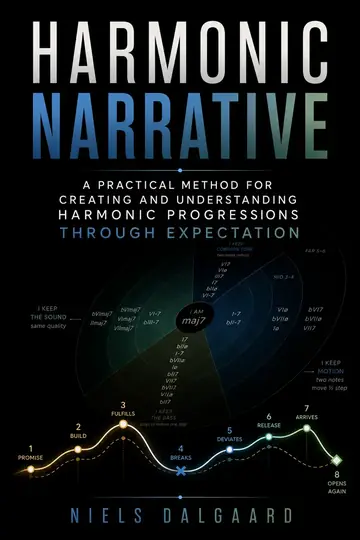
Every one of these tunes is assembled out of the same handful of harmonic resources. Jazz Harmony is those resources, explained in the order in which they build on each other.

| Chord | Roman numeral | Function | What it is doing | Confidence |
|---|---|---|---|---|
| Gmaj7 | I | Tonic | Gmaj7 is the tonic of G. It is where the progression is at rest. | High |
| E7 | V7/ii | Dominant | E7 is functioning as V7/ii: a secondary dominant. It is the dominant of A, not of the home key, so it borrows the pull of a V-I and points it at ii instead. | High |
| Am7 | ii | Predominant | Am7 is the ii chord of G: the classic predominant. It prepares the dominant and almost always moves to it. | High |
| D7 | V7 | Dominant | D7 is the dominant of G. Its third and seventh form a tritone, and that tritone is what makes the tonic feel due. | High |
| Gmaj7 | I | Tonic | Gmaj7 is the tonic of G. It is where the progression is at rest. | High |
A complete ii-V-I in G. Predominant, dominant, tonic: the sentence jazz harmony is built out of.
The progression closes with an authentic cadence in G.
High, medium and low next to each numeral are judgements about musical context, not probabilities. A low rating marks a bar that can honestly be read more than one way. How the ratings are decided →
Read in G major, these bars come out as I – V7/ii – ii – V7. Inside those 5 chords there is a complete ii-V-I and at least one secondary dominant. The shortest way in is a two-voice reduction: third and seventh only, slowly. E7 contributes G# and D, and where that pair resolves is the whole story of the passage. You will meet the same move again in Stella by Starlight, How High the Moon and Ornithology, transposed and at a different pace.
A ballad in which almost every chord is a secondary dominant preparing the next, so the harmony is in continuous motion while the melody takes its time — the same combination as Georgia on My Mind but denser. The bridge moves to the relative minor and stays long enough to change the mood. The tune is generous to a soloist because every one of those dominants offers an obvious place to add tension, and it is one of the standard vehicles for learning to alter a dominant chord without losing the thread.
George and Ira Gershwin wrote it for Girl Crazy in 1930, the same show that produced I Got Rhythm. Charlie Parker recorded two takes of it in 1947 that are among the most transcribed performances in the music — the two differ almost completely from each other, which is why they are usually studied as a pair rather than singly.
The excerpt is loaded and editable. Swap a chord for its tritone substitute, delete the preparation, borrow one from the parallel minor, and watch which numerals change and which do not.
What this device is, and the other standards in the library that use it.
Read →What this device is, and the other standards in the library that use it.
Read →Victor Young · 1944 · B♭ major
Chord progression →Morgan Lewis · 1940 · G major
Chord progression →Charlie Parker · 1946 · G major
Chord progression →The families every standard is assembled from, with examples from the library.
Read →